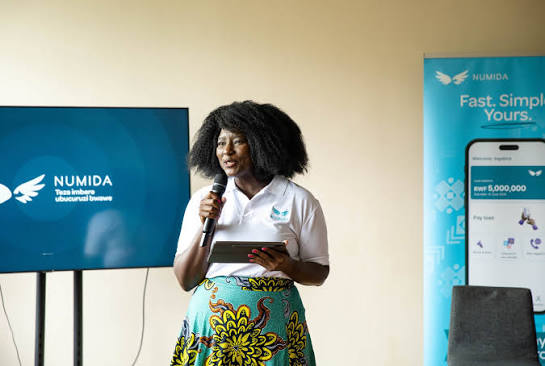

Kenya does not lack for lenders. It lacks the right ones. That distinction sits at the centre of Numida‘s formal entry into the country, and it is the argument its Chief Operating Officer, Lorraine Mutambiranwa, has come to Nairobi to make.
The Ugandan fintech launched its Kenyan operations in late June, positioning itself not as another instant-loan app but as a financial partner for established business owners. It is a deliberate move up-market, into what the company calls a premium lending proposition, and it lands in a country that has already built one of the most sophisticated digital credit ecosystems on the continent.
The pitch rests on a diagnosis. Kenya has more than 7.4 million micro, small and medium enterprises employing over 14 million people, yet many still struggle to secure financing that is both affordable and matched to how their businesses actually run. Traditional lending is slow and collateral-heavy. The digital alternatives are fast but built for short-term liquidity, not expansion. Numida is betting that a serious tier of Kenyan entrepreneurs has outgrown both.
The alignment problem
Mutambiranwa frames the gap in the interview she gave The Star not as a shortage of capital but as a failure of fit. Kenyan entrepreneurs are ambitious, she notes, and there is no scarcity of lenders. The problem is that financial products rarely reflect the realities of running a business: seasonal demand, irregular cash flows, supplier relationships and working-capital cycles that do not sit neatly inside conventional lending models.
Her language is careful throughout. Success, she argues, is not measured by disbursement volume. An over-indebted customer may generate short-term growth for a lender but produces no lasting value. Responsible lending, on her account, builds trust, and trust is what turns a single loan into a durable commercial relationship.
That is the philosophical distance Numida is trying to open between itself and Kenya’s instant-loan culture. Instant lending, she concedes, expanded access and made borrowing convenient. But it is organised around a transaction. Numida’s model, she says, is organised around a relationship. She offers a Machakos customer as the illustration: the conversation was not about how much he could borrow that day, but about opening a second branch, buying equipment and planning future expansion.
The mechanics
The model is not sentiment. It is process. Numida combines digital loan processing with relationship management, issuing loan decisions within 24 hours while running business documentation reviews, mobile-money statement analysis and, for first-time borrowers, in-person verification.
The target customer is specific. Numida is aiming at established entrepreneurs with monthly revenues of KES 300,000 (about US$2,300) and above, business owners who require financing that matches the scale of their ambitions rather than the ceiling of a mobile wallet.
The company arrives with a track record to point to. Operating across East Africa since 2017, Numida has supported more than 120,000 MSMEs across Uganda, Rwanda and Kenya, disbursing over US$170 million (roughly KES 22 billion) in working capital. Its Rwandan entry came earlier in 2026 with collateral-free loans aimed at the same underserved segment. The expansion is underwritten in part by a US$12.3 million round led by Serena Ventures in 2022, capital raised precisely to enter new markets.
The bet, and its timing
There is a harder read on all of this, and it belongs in the same frame as the optimism. Numida is entering Kenya at a moment when businesses are increasingly struggling to service their debt, with non-performing loans in the banking sector climbing to a 12-year high. A relationship-led model that leans on deeper underwriting is, in one sense, a rational answer to exactly that risk. It is also an expensive way to lend, and the market will test whether patient credit can hold its discipline when the surrounding environment is deteriorating.
At the launch, held in Nairobi, the company made its thesis visible. Established business owner George Omondi was presented with a cheque of KES 225,000, flanked by Mutambiranwa and Numida Kenya Operations Manager Joy Ndong’a, a small piece of theatre standing in for the larger promise of faster, fairer and more predictable working capital.
Mutambiranwa closes on the human dimension, and it doubles as a warning to anyone reading a balance sheet too literally. A viable business, she argues, does not automatically qualify as a lendable one under conventional indicators. Some of the most successful entrepreneurs she has met are builders, traders and manufacturers, not financial experts, people whose strength never shows up in formal records. Reading them correctly is the whole proposition. Whether Numida can do it at scale, in Kenya’s most competitive and most stressed credit market to date, is the question the next two years will answer.


